
Candlestick Pattern
Bullish
The Mat Hold द मैट होल्ड
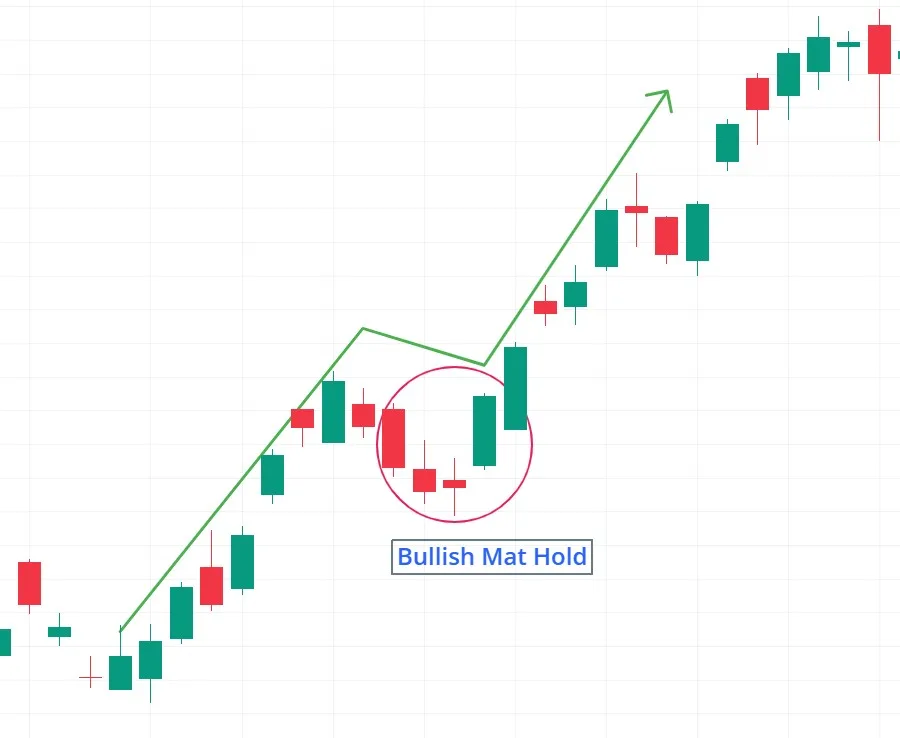
A five-candle bullish continuation pattern that forms during an uptrend. एक पांच-कैंडल वाला बुलिश कंटिन्यूएशन पैटर्न जो अपट्रेंड में बनता है
Pattern Overview
Definition & Type
- A five-candle bullish continuation pattern that forms during an uptrend.
- Signals strong buying pressure that resumes after brief consolidation.
Reliability
- Highly reliable when accompanied by strong volume.
- Particularly effective in well-established uptrends.
Formation & Structure
Formation
- Number of Candles: 5 candles
- Visual Description:
- First Candle: Long bullish candle (continuing the uptrend)
- Second Candle: Small bullish candle within first candle's range
- Third & Fourth Candles: Small-bodied candles showing consolidation
- Fifth Candle: Longer bullish candle breaking above first candle's high
- Key Identification Criteria:
- Must form in a clear uptrend.
- Fifth candle must close above first candle's high.
- Consolidation candles should stay within first candle's range.
Psychological Interpretation
- Market Sentiment:
- Bulls dominate initially (first candle).
- Temporary profit-taking causes brief consolidation (middle candles).
- Bulls regain control decisively (fifth candle).
- Trader Behavior:
- Sellers fail to reverse the trend.
- Buyers reassert dominance after short pause.
Example
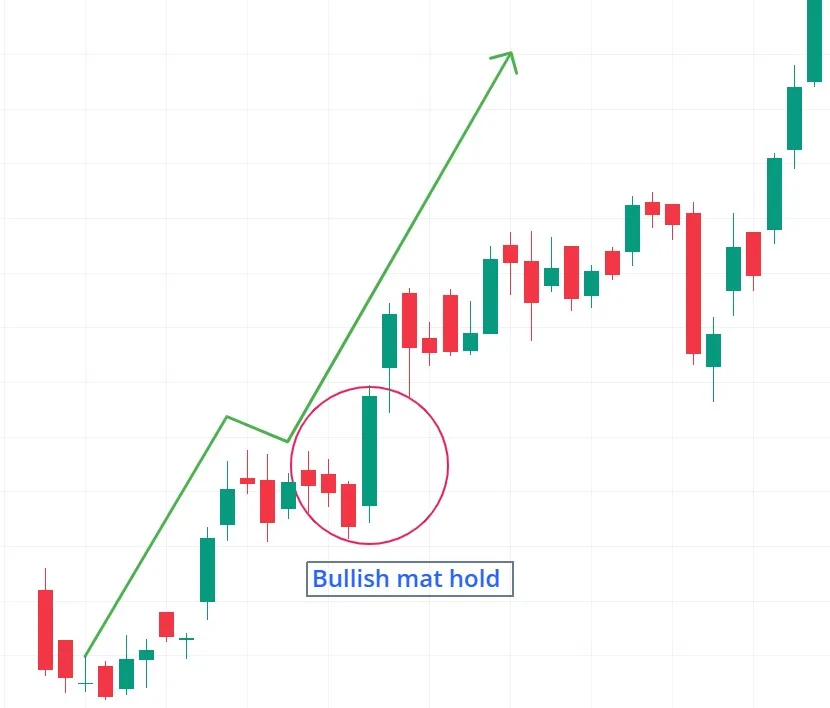
- Example (Stock: xyz):
- Long green candle after a 3-day rally.
- Next 3 days show small consolidation candles.
- Fifth day breaks out strongly to new highs.
- Price Action: 15% gain over next 2 weeks.
Strategic Insights
Entry & Confirmation
- Traders typically wait for fifth candle to close above first candle's high.
- Many combine with ATR or MACD for confirmation.
Trigger Point & Targets
- Trigger Point usually placed below consolidation area.
- Targets often set at 1.5:1 or 2:1 risk-reward ratios.
Risk Management
- Experienced traders risk no more than 1% of capital.
- Volume analysis is crucial – high-volume breakout preferred.
Pro Tips
- “Mat Hold patterns above the 50-day MA are more reliable.”
- “Consolidation candles staying above first candle's midpoint is favorable.”
Common Pitfalls
Misinterpretations
- Novices often mistake any five-candle consolidation for Mat Hold.
- Some enter before breakout confirmation.
Expert Advice
- Seasoned traders avoid low-volume breakouts.
- Experts recommend combining with support levels.
Related Patterns
Similar Patterns
- Rising Three Methods – Similar but with three consolidation candles.
- Bullish Pennant – Consolidation candles in a narrowing range.
- Bearish Mat Hold – Inverse pattern in downtrends.
Knowledge Check
True or False
- The Mat Hold pattern requires the fifth candle to close above first candle's high.
- (Answer: True – This confirms the breakout and completes the pattern)
पैटर्न अवलोकन
परिभाषा एवं प्रकार
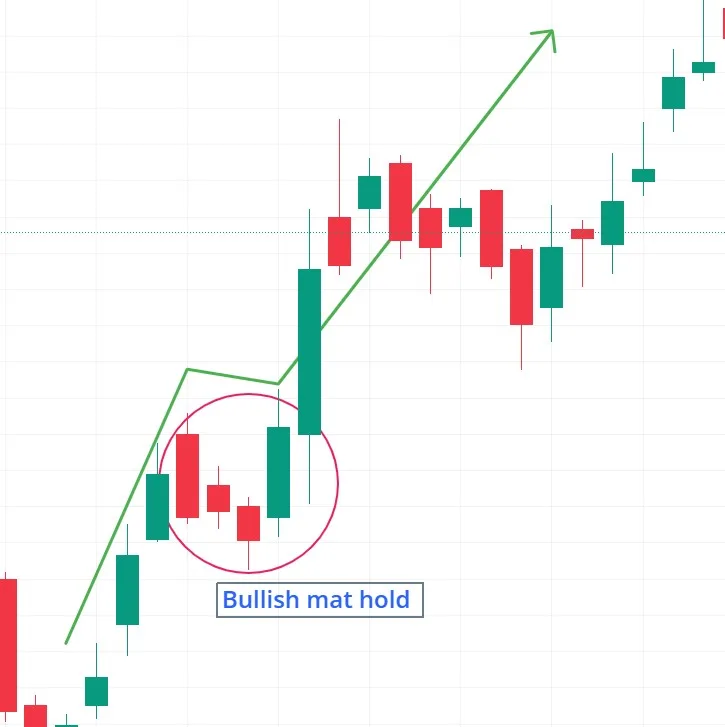
- एक पांच-कैंडल वाला बुलिश कंटिन्यूएशन पैटर्न जो अपट्रेंड में बनता है
- मजबूत खरीदारी के दबाव को दर्शाता है जो संक्षिप्त समेकन के बाद जारी रहता है
विश्वसनीयता
- उच्च मात्रा के साथ बनने पर अत्यधिक विश्वसनीय
- लंबे समय तक चलने वाले अपट्रेंड में विशेष रूप से प्रभावी
गठन एवं संरचना
गठन
- कैंडल संख्या: 5 कैंडल
- दृश्य विवरण:
- पहली कैंडल: लंबी बुलिश कैंडल (अपट्रेंड जारी)
- दूसरी कैंडल: छोटी बुलिश कैंडल जो पहली कैंडल के रेंज के भीतर बनती है
- तीसरी एवं चौथी कैंडल: छोटे बॉडी वाली कैंडल (समेकन)
- पांचवी कैंडल: पहली कैंडल के हाई से ऊपर बंद होने वाली लंबी बुलिश कैंडल
- मुख्य पहचान मानदंड:
- स्पष्ट अपट्रेंड में बनना चाहिए
- पांचवी कैंडल को पहली कैंडल के हाई से ऊपर बंद होना चाहिए
- समेकन कैंडल पहली कैंडल के रेंज के भीतर ही रहने चाहिए
मनोवैज्ञानिक व्याख्या
- बाजार भावना:
- खरीदार शुरू में नियंत्रण में होते हैं (पहली कैंडल)
- अस्थायी लाभ लेने से मामूली समेकन होता है (मध्य की तीन कैंडल)
- खरीदार फिर से नियंत्रण लेते हैं (पांचवी कैंडल)
- भागीदार व्यवहार:
- विक्रेता प्रवृत्ति को उलटने में असमर्थ होते हैं
- खरीदार संक्षिप्त विराम के बाद फिर से प्रभुत्व स्थापित करते हैं
वास्तविक विश्व उदाहरण
- उदाहरण (स्टॉक: xyz):
- 3 दिन के तेजी के बाद पहली लंबी हरी कैंडल बनी
- अगले 3 दिन छोटी कैंडल में समेकन हुआ
- पांचवे दिन नई हाई के साथ मजबूत ब्रेकआउट हुआ
- मूल्य व्यवहार: अगले 2 सप्ताह में 15% की वृद्धि
रणनीतिक अंतर्दृष्टि
प्रवेश एवं पुष्टि
- व्यापारी आमतौर पर पांचवी कैंडल के पहली कैंडल के हाई से ऊपर बंद होने की प्रतीक्षा करते हैं
- कई ATR या MACD के साथ संयोजन करते हैं
Trigger Point एवं लक्ष्य
- Trigger Point आमतौर पर समेकन क्षेत्र के नीचे रखा जाता है
- लाभ लक्ष्य अक्सर 1.5:1 या 2:1 जोखिम-इनाम अनुपात पर सेट किए जाते हैं
जोखिम प्रबंधन
- अनुभवी व्यापारी पूंजी के 1% से अधिक जोखिम नहीं लेते
- वॉल्यूम विश्लेषण महत्वपूर्ण है – ब्रेकआउट पर उच्च मात्रा आवश्यक है
विशेषज्ञ सुझाव
- “मैट होल्ड पैटर्न 50-दिवसीय मूविंग एवरेज के ऊपर अधिक विश्वसनीय होता है”
- “समेकन कैंडल का पहली कैंडल के मध्य बिंदु से ऊपर रहना अच्छा संकेत है”
सामान्य गलतियाँ एवं सावधानियाँ
गलत व्याख्या
- नए व्यापारी अक्सर किसी भी पांच-कैंडल समेकन को मैट होल्ड समझ लेते हैं
- कुछ ब्रेकआउट की पुष्टि से पहले ही प्रवेश कर लेते हैं
विशेषज्ञ सलाह
- अनुभवी व्यापारी कमजोर मात्रा वाले ब्रेकआउट से बचते हैं
- विशेषज्ञ समर्थन स्तरों के साथ संयोजन की सलाह देते हैं
संबंधित पैटर्न
समान पैटर्न
- राइजिंग थ्री मेथड – समान कंटिन्यूएशन पैटर्न लेकिन तीन समेकन कैंडल
- बुलिश पेननेंट – समेकन कैंडल संकुचित रेंज में होती हैं
- बेयरिश मैट होल्ड – डाउनट्रेंड में बनने वाला उलटा पैटर्न
ज्ञान परीक्षण
True or False
- सही या गलत: मैट होल्ड पैटर्न के लिए पांचवी कैंडल को पहली कैंडल के हाई से ऊपर बंद होना आवश्यक है।
- (उत्तर: सही – यह ब्रेकआउट की पुष्टि करता है और पैटर्न को पूरा करता है)